Wednesday, 10 August 2011

John Niven - Kill Your Friends

"The nature of show business means that people within the business feel that if someone else fails, they move up a notch." - Tom Arnold.


"You can't spell 'star' without A and R." - Ronnie Vanucci
Kill Your Friends by John Niven is a book about greed, fuelled by conscious desire to stab your nearest rival in the back (or smash their head in with a baseball bat after feeding them insane quantities of coke and valium) in order to gain the ultimate prize - to be the one on top of the pile. It's a snapshot of the life of Steve Stelfox, an A&R man for an unnamed music company and his various day-to-day dealings, sufferings and insane hedonism. The book is laced with black humour, large amounts of profanity and drug taking. In fact, you'll be hard pressed to find a page that doesn't feature Stelfox or one of his odious comrades snorting something. 


Ross

Kill Your Friends is one of the funniest books I have read in a long, long time. Niven's writing is bitter, caustic and roars with a fiery hate - I couldn't help but find it anything but hilarious. The book is divided into 12 chapters, each with a short scathing blurb on the current musical climate. For instance, April’s reads: “R.Kelly is no. 1 for a fucking month….whispers start to circulate that the new Radiohead LP is off its tits – an unlistenable prog-rock nightmare.” These short pieces are laden with hype and pretension – label bosses blithering about certain bands being around “longer than 18 months”; certain acts being “retro and contemporary” (Jimmy Fucking Ray, I ask you) and my favourite from March being this: “I see her developing the way Madonna has. This is the dance album of the decade” (on Gina G).

Steve Stelfox, the anti-hero of the piece, is the focal point and his whole life and view of just about everything seems to be motivated entirely by hate. He's a racist, pessimistic, homophobic, misanthropic degenerate obsessed with image and rank. He's barely got time for anyone; which makes the title somewhat of a misdemeanor. Stelfox doesn't have any friends. He's surrounded by acquaintances he can't stand - people he loathes; people he wishes he could kick down the stairs and stamp on until their brains pop out.

Yet, he's never actually openly nasty or voices such attitudes. It's nearly all in his head; this outpouring of bile is restrained behind a wall sleazy A&R spiel and chang that only we can see and experience. It only truly breaks through during 2 key moments in the book where events begin to slip into what I would call a diet-version of American Psycho. These moments are when the book starts to take a long hard look at the dark side, embracing it with open arms – it also says a lot about Stelfox and how influential he is at corrupting people. Hey, he might be a bit “swing and a miss” on some acts he’s signing, but manipulating people? Hell, he wrote, published and sold the t-shirt on that.

Stelfox isn't crazy though - he's just bored. He doesn't care about music, he's all about money and his life is one uncontrollable wreck of staggering from one line of coke to another, whilst trying to find an act/song/group/artist that the tolers (everyone that isn't Stelfox and his associates) and boilers (see here) will lap up. I suppose fear is something that flows through this book - the fear of failure. Stelfox is terrified of failing, so are his entourage of grinners; Trellick, Dunn, Ross, Hastings, Darren and Waters. All of them are absolutely petrified, but they hide it well - it's masked by copious amounts of alcohol, sex and drugs. This is then manifested into hate – so in effect, Kill Your Friends is about the turning of one negative, crippling emotion into another, forming this never-ending cycle of hell and desperate survival.


Now, you might be under the impression that this is a depressing read - far from it. It's so unrelentingly scathing, gratuitously vulgar and dripping with black humour - you'll have trouble keeping a straight face. It's packed with some truly superb scenes and chapters such as in June when they go to Glastonbury and shit begins to hit Stelfox's fan; Rage's 64 minute single, the burning hatred for Parker-Hall, pages 23 to 28 being absolutely INCREDIBLE reading (or depending on your copy, the chapter that starts "a couple of words for all you hopefuls out there in unsigned bands: Fuck. Off".), as well as Stelfox's own deviousness and planning, which has a scary Eric Cartman meets Blackadder quality.

I struggled to put this down; Niven has a real talent for creating a series of characters with truly repulsive traits that I couldn't get enough of.

Sen-say-shunal.

"Artists and records come and go...record companies are forever" - Anonymous lawyer.

Saturday, 16 July 2011

Vonnegut VS Lewycka: FIGHT!


I can't eat meat, and I don't drink.

Note that I didn't say I'm a tee-total vegetarian. Thats something completely different. When I eat meat, my body switches into some kind of annoying standby mode for an hour while I digest. I find it hard to concentrate enough to watch TB in this mode. Cutting out meat gave me back two hours in the day, so it seemed like a no-brainer.

As for the drinking, recently I've found that drinking causes a livid rash to appear over my feet. It's the same rash that heralded me going into hospital in 2008, except back then I thought it was an allergic reaction to pinching my flatmates washing powder. It wasn't; it was the first part of a massive vascular breakdown that almost killed me.

So, recently, I've been cutting out the drinking.

What these two things mean is that I'm not like you. I don't regard this non-drinking vegetarian lifestyle as making me better - being a vegetarian is like belonging to a rubbish secret club - but I'm not like you because I know I'm going to die. Unlike you, my number could come up at any time, no matter how much care I take.

If you're reading this, you're probably going to get at least another 10 to 20 years of lifespan. I don't know how long I'll live. I have no guaranteed survival. Prior to 2008 the greatest threats to my lifespan had been cycling in heavy traffic and putting my trousers on at the top of the stairs.

Which is why A Short History of Tractors in the Ukranian is, for me, such a repulsive book, and why Slaughterhouse 5 is so great. A Short History of Tractors in the Ukranian is about people who all fail; about a humanity who are never any more than their history, and who are to be laughed at for their very human nature. Slaughterhouse 5, on the other hand, is a picture of humanity who fail, are miserable, sometimes evil, often misunderstand each other, but are still, somehow, worth examining for their wonderful individuality.

You'll excuse me if, during my short time here on earth, I choose to see humanity in the way that Vonnegut lays out.

(Maybe I will live long enough to grow so old and cynical as to enjoy A Short History of Tractors in the Ukranian's version of humanity. So it goes.)

Thursday, 23 June 2011

Kurt Vonnegut - Slaughterhouse Five


So it goes...
 Slaughterhouse-Five by Kurt Vonnegut is a book overloaded with genres and satirical wit. Part science fiction thriller, part war-journal, all tied up with elements of time travel and pre-determined events, it crams in a lot of information for something that is under 200 pages in length. It focuses on Billy Pilgrim, a soldier during World War 2, who appears to flit back and forth along his own time line experiencing himself before, after and during captivity by Germans at the Battle of the Bulge. A race of aliens, know as Tralfamadorians (who resemble upright toilet plungers with one green eye) abduct Billy and teach him about forth dimensions. Confused? It’s a bit of a mind-screw to say the least.

Ross:

I’m not sure if there was a part of me that didn’t ‘get’ this book – I think perhaps a ‘me’ in another dimension probably understood it and herald it as “the greatest thing since Halo Reach.” I got quite hung up on the time travel aspect, which I’m afraid is going to reveal my ignorance, as I viewed the book and Pilgrim’s jumping around not as something like a series of cuts in a tv show or film (which, after discussion - it perhaps was written as this, so it goes). I viewed or experienced Pilgrim's life as a  progressive piece – he was ACTUALLY travelling in time from my perspective, begging the question – why didn’t anyone say “where the hell did you come from?” every time he popped into view. Then I came to understand – Pilgrim is perhaps everywhere – he is existing all the time on his own time line, everything that is happening to him is happening at the same time, including his death, even though he’s not really dead, because as the Tralfamadorians state, “at some point you are both dead and alive all the time” – Aliens, eh? Bunch of forth dimension wackjobs if you ask me.

There’s not much to say about Billy Pilgrim; a character that was fairly one-dimensional, who was for all intensive purposes, trapped to face inevitability. He was nothing more than a porter guiding the reader through his mind; one that was so fragmented and disjointed due to being unstuck in time. He showed little or almost no emotion; playing the part of someone struck dumb and seemed devoid of any real warmth and feeling. I felt myself not really caring for the character, which had no real life. In fact, I found I pitied him more than anything.

I admire Vonnegut’s style – his constant use of the arc words, “so it goes”, his inclusion of an author avatar in the form of Kilgore Trout (a man that has a militia of paper boys under his command because he’s too old and lazy to deliver them himself). The way he constantly mentioned the fate of Edgar Derby, laying it on so thick, you could have built a house with the amount it was referenced – and then Vonnegut has Derby shot in a throw-away sentence, leaving you wondering the point to such a build up but admiring the way such a character is so heavily referenced and then dispatched like someone crossing out an offending line of text.

Part of me wonders if the book is all about acceptance – it’s about resigning yourself to a fate that you know is going to happen, so why bother changing it. That’s the attitude the Tralfamadorians have – why bother, when you know you might as well make the most of what you’ve got and be happy. I suppose this is easy to say for something that resembles a toilet plunger on legs; I mean, life can't get any worse, right?

Thursday, 2 June 2011

WE READ MOBY DICK AND ALL WE GOT WAS THIS LOUSY BLOG-POST

IN THE BELLY OF THE WHALE
Moby Dick by Herman Melville, is considered one of the Great American Novels. Published in 1851, it tells the tale of a sailor named Ishmael and details his experiences onboard the whaling ship, the Pequod. Much of the main focus of the novel is on the fanatical, one-legged Captain Ahab, who is seeking revenge on Moby Dick, the sperm whale that destroyed his last boat and left him crippled. Apparently based on a true story of a whaling ship The Essex that was attacked by a sperm whale at sea.

Pete:

So, we just finished reading Moby Dick. Four of us made it to the end, which is pretty good going - it’s a famously hard book. Most people who pick it up don’t finish it, and most of the people who finish it are confused by it. It’s a classic novel, but it might not be a good book.

Funnily enough, there’s a book group in Bedford who are tackling Moby Dick as well. I know this because my Dad goes to an education centre for retired people in Bedford, and some of his friends are doing Melville’s tale of the whale in their book club. These are all old, smart people, and most of them sound like they are completely lost with the book. But it’s one of those books, right? The sort of book that you are supposed to read in book clubs.

Next up for our book club is Kurt Vonnegurt’s Slaughterhouse 5. I’m really looking forward to that. I haven’t read a lot of Vonnegurt, but I’ve read a few. There was a time in my life when I only read scifi, specifically scifi set in deep space, and when I ran out of those I started reading other things. One of those other things was a few Kurt Vonnegurt books, which I enjoyed.

A few years ago I was on a long train journey, and the woman sat next to me was reading Slaughterhouse 5.
“Oh wow, Kurt Vonnegurt!” I said to the not-unattractive woman, thinking she had some nerd credentials that I could bond with. “I really like his work.”
“I’m reading it for my book club,” she said, “and I’m really hating it.”
Oops.

After Slaughterhouse 5, we’ll all be seeking out copies of “A Short History of Tractors in Ukrainian”, (ASHOTIU) [1] by Marina Lewycka. I’m not looking forward to this book. To me, it looks like the sort of thing that is supposedly worth reading, but will end up boring the snot out of me. A few years ago I would have dismissed it out of hand for having no spaceships, but I’m a bit more mature these days. What it does have, however, is the full backing of the Bedfordshire Library Service, as ASHOTIU [2] is one of the books in their Reading Groups Collection.

The Reading Groups collection is a list of books that Bedfordshire libraries has multiple copies of, so they can be lent out en masse to book clubs like us. Well, not quite like us, because we are a bad-ass book club and we don’t take no snot-boring books. Apart from this one [3].

Personally, I enjoyed Moby Dick. It was mostly a good book, which was good enough for me. But it’s obviously one of those books that people in book clubs feel they should read, as is Slaughterhouse 5, as is A Short History of Tractors in Ukrainian.
This is weird, because there are a lot of books. I mean, of all the books ever written, how come we end up mining this vein of similar material for book clubs? Why are we all reading the same stuff?

That’s why I’m not going to waste your time giving you my review of Moby Dick. Smarter people than me have written about Meville’s opus. Instead, I’m going to give you a list of other book. Instead, I’d like to use this space to leave a list of books that are good, but not ordinarily read by book clubs. If you’ve got suggestions, please leave them in the comments.

[1] Bless you
[2] Bless you. Aw, you must have caught the sniffles.
[3] And Sebastian Faulk’s shit-awful “A Night in December”, which is almost an argument for book-burning because of it’s fucking middle-class smugness.

Pete's Book Suggestions:
1 - Corvus, by Esther Woolfson - I'm hearing amazing things about this memoir of raising a crow. It's a non-fiction book about animals, which is pretty far away from the regular book-club territory, whilst still being fairly mainstream...

2 - Bone, by Jeff Smith - the epic comic tale of the 1990s and early 2000s, which has a comprehensive website at http://www.boneville.com/. I actually cried at one point when I read this. The only downside is that it's kinda expensive because it's an extremely large comic book

3 - For I Have No Mouth and I Must Scream, by Harlan Ellison - Ellison, the bad boy of SF, wrote this seminal short story of science fiction in 1967. I've never read it, but the wikipedia entry gives me the heebie jeebies.

Ross:


Becky:

I didn't enjoy Moby Dick. I'm not one to shy away from classic literature (I mean I studied English at university, so that would be a pretty poor choice if I did), but I'd put Melville's novel in the same box as James Joyce's Ulysses (which I did attempt once and didn't get very far with), in that it's one of those books that is notoriously difficult to finish. Oh well, maybe one day Joyce.
Anyway, I did manage to finish this and I'm pretty proud of myself for it, just because it was such a long, hard slog. I can safely say this book is just not my cup of tea and because of that I'm not even going to attempt a proper review. This book requires serious academic analysis before you can even scratch the surface and begin to appreciate all of what Melville is trying to say here, and even though I didn't personally enjoy it I can still appreciate that technically speaking it is a work of brilliance. If you seriously want to read Moby Dick and think you may enjoy it go and find some essays on it first and really get stuck in.
If you have absolutely no interest in the history of the whaling industry then the chances of you finishing are doubtful (the ratio is about 20% actual story and 80% whaling facts). You also don't get to see THE whale until page 446 and the story ends on page 469.

My copy also tells me that this is: “the greatest novel ever written by an American.” Well, I can think of a few American writers that I would read over before I'd contemplate picking up Melville's Moby Dick again: Fitzgerald, Steinbeck, Poe, Hawthorne, Capote, Kerouac, Lee, Salinger, Yates, Chandler, Cain, Hammett, McCoy, Alcott...
… I could go on, but I'm sure you get the idea.

And ignore Pete and his crankiness, I'm optimistic about the next couple of book club choices, but then, nothing could be worse than that damn Warlock book a few posts back.

Saturday, 30 April 2011

Poppy Z. Brite - Lost Souls

Blood, blood, blood, blood etc.
Lost Souls is the debut horror novel of Poppy Z. Brite, released in 1992; back when writing about vampires wasn’t the norm. It features five main characters:

 Steve – a stubborn, violent alcoholic, who plays guitar in the band, Lost Souls.
Ghost – best friend of Steve and vocalist for Lost Souls. Prone to visions and traits of empathy and psychic abilities.
Nothing – teenage vampire on a ‘coming of age’ quest to locate his real family – is a fan of Lost Souls.
Zillah – an androgynous, green-eyed vampire prone to cruel and insensitive acts. Connected to Nothing in certain ways, if you will.
Christian – an old-school vampire, who unlike Zillah, cannot tolerate sunlight or imbue food or alcohol.

Other characters include two more Vampires, Twig and Molochai; both childish and idiotic, along with Ann, Steve’s ex-girlfriend, Arkady Raventon, a sinister magic shop owner and Jessy, Nothing’s biological mother, devoted to the myth of the vampire.

The novel revolves around a club in Missing Mile, just outside New Orleans where kids dress in black, seeking acceptance. In step Zilliah, Twig and Molochai, who Jessy, a confused 15 year-old runaway, has been searching for. Steve and Ghost soon get drawn in and must choose whether to save a life or seek revenge, whilst further events just become more and more twisted. It’s one of those kinds of books.

Pete:

Lost Souls is a blood-soaked gender-bending book that tries hard to be as transgressive as possible. Sadly, that transgression wears off after the gory introduction, unless you find florid descriptions of homosexual sex shocking. And there is a lot of man-on-man action in this book.

Being neither gay, nor inclined towards "goth" subculture, I felt that this book was a complete loss for me. The text had a workman-like quality to it that struggled to find poetry in pre-Katrina New Orleans and other settings, but managed to be perfectly serviceable in terms of moving the plot along. Mysteriously the book, and the author, seem to have a rabid fan base. Why? In the front of my library copy was a review from Amazon that stated "this book will make you cry". This book couldn't even make me cry with boredom, so why are people so passionate about it?

Perhaps it's the vampire mythos. All of the major vampire stories around in contemporary fiction have ardent fans (hello, TwiHards!) and the blood-and-guts approach taken in Lost Souls makes the book stand out. A little. I don't want to get into a long analysis of why beautiful ageless immortal rapists are so popular in fiction, as I'm just going to chalk it up as some flipside of fascination with celebrity.

(Because, really, aren't these vampires just bad-to-the-bone versions of celebrities? We're allowed to think that maybe we can be famous, so perhaps the antihero nature of vampirism appeals to the narcissistic tosser in all of us?)

It doesn't seem like there will be a shortage of tossers anytime soon, so Lost Souls will continue to draw people in with its depiction of empty, hollow sexual acts, and gory but boring deaths.

BONUS MATERIAL:

Russel Brand's thoughts on celebrity in contemporary society are worth listening to, considering his Byronic public persona is as close to the traditional literary vampire as you can get:


Ross:

Oh god, where to start? Right, let’s get this out of the way straight off – I am NOT the target audience for this book. A sexually confused 15 year old, floppy haired, dresses in black Marilyn Manson fan? Shit, you’ve probably got 3 copies of this with different covers, all in hardback, plus the connecting short stories and a poster on your wall, all signed by the author - probably in blood.

I would like to kick off with some praise first; this book was actually a fairly straight forward read – the plot, such as it was, ran smoothly, the main characters well fleshed out and the descriptions, fairly explicit. However, despite it being easy to follow – I just didn’t care. With the exception of Ghost, none of the other characters (around 10+) had any redeeming qualities whatsoever. I mean, everyone likes reading about a bastard, but it’s nice if the bastard actually goes home from his day of bastardry and we find out he looks after a load of kittens; or works part time in a nursing home. For the most part, they all seem to be lost in a heady competitive world of ‘who can I fuck over the most to get what I want?’ The world itself seems completely crapshack – there seems to be little or no authority; the amount of bodies that pile up due to Zillah, Molochai, Twig and Christian’s actions barely calls a sniff from the local constabulary, save for once in the novel over the death of a young boy, which is then never mentioned again. If Barnaby had been sniffing around, you bet he would have caught them – just follow the trail of bodies – shit, even Reg Hollis would have had a chance.

I found myself hating a lot of the characters – they were pretty much all hedonistic wasters (Ghost and Steve aside, the former being a weirdo and the latter being an alcoholic rapist), even Ann, who having fallen under Zillah’s thrall, was desperate to be with him, even though halfway through the novel he fucks her then chucks her. Chicks love bastards. They all seemed completely untouchable and unfazed regarding their immoral actions, something which I suppose comes with having no soul and fangs.

Actually, I felt some compassion towards Steve, the anti-hero of the piece. Written as a complete jerkass and a rapist (of Ann), he was incredibly troubled and tortured person, who held my interest more than the flamboyant and enforced wackiness of the vampires, who were beyond tedious in their thrust-it-in-your-face homo eroticism and blood-drinking foreplay. Steve and Ghost’s relationship and bond was the only part that actually kept me going with this novel; had it centered much more on them, then perhaps I’d view the whole experience differently; then again, the book would just be a weird road-trip diary of a drunk who robs vending machines, a white-haired weirdo who can read minds and them both occasionally kissing but “totally not in a gay way, dude” (see near the end of the book, where they both share quite a tender moment together).

Also, how often is the word ‘blood’ used in this book? I’m surprised this book wasn’t printed on red paper. Beyond tedious; but I would love to see what the Stephenie Meyer fanclub would think to this.

Additional:

We have a new member to book club! Stuart Adams, illustrator extraordinaire as joined our ranks and came to his first meeting the other week – hopefully we didn’t scare him off with are chaotic rambling.

Thursday, 21 April 2011

Steve Jackson & Ian Livingstone - The Warlock of Firetop Mountain

WARNING! Please pass a luck test on 2D6 to view the rest of this page.

"You are at a crossroads....."*book hits wall*


The Warlock of Firetop Mountain is a single player adventure game book created by Steve Jackson (we are not worthy) and Ian Livingstone (likewise), where you (YES YOU, THE HERO) must take on a perilous quest up said mountain and defeat an evil Warlock, smiting various enemies along the way, opening boxes and spending a lot of your time standing at crossroads. Dice are involved, as is the painstaking task of recording down every movement (if you are a massive loser like me), your equipment, skill, stamina, luck (which are all predetermined by dice rolls) and what potion you will take and inevitably forget to use.

Ross

This was a nostalgia trip more than anything else. Having ‘read’ (or should that be played?) both Portal of Evil and Deathtrap Dungeon by Messrs Livingstone and Jackson back when I was 13, experiencing the giddy heights of dice-rolls, scribbling down stats and breathing a sigh of relief when I manage to roll under 5 on 2D6 took me back.

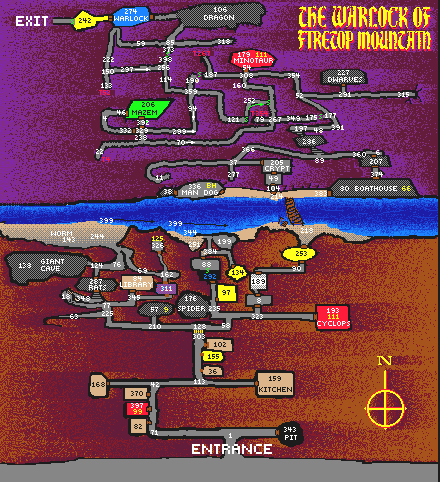
Like all wistful reminiscing, it wasn’t without its “oh god, not that...” aspect. For one thing, I spent a good portion of my “journey” lost in a maze of corridors somewhere in the middle of the book. The amount of times I dodged between pages 52, to 308 to 117 back to the crossroads before being chased by a Goblin meant the book saw itself take flight across my room in frustration. This was my own stupidity, not the books fault - it couldn't change the way it was written. The only thing that could be changed was what pathway I took and unfortunately I had the habit of wandering around like Stevie Wonder on a LARPing weekend.

When it came to actual combat though, the thrill of matching my character (in the first case, Staff Sergeant Max Fightmaster) against a couple of Orcs was met with a fist-pump of joy. My many years of wargaming, (not that it came in handy, as dice rolls are, after all, all down to luck); but my passion for it, was rekindled and meant that the breaks in the text (such as it was) didn’t bother me in the slightest.

The writing is fairly simplistic and straightforward descriptions of your surroundings and the foes are given, with pictorial aids scattered about. There is no need for complex depth, as this is supposed to be a game; the need for long passages of text is negated and instead replaced by curt descriptions and orders that you, the adventurer must undertake. It almost felt like an instruction manual (with half the pages missing or in the wrong order) to being a big damn hero.

Another thing to consider with a Fighting Fantasy book is control and also the lack thereof. In some ways, both are present when you start up the quest – the decision is yours whether to go North or South, East or West, run at the old man waving your sword like LLLLEEERROOOYYY JJJJEEENNNKKIINNNSSSS or drink mead with some dwarfs. But the dice rolls then take over, eliminating your control, putting you in the hands of fate – and in battle, fate is all you’ve got to hold on to really to defeat the various pitfalls, monsters and pass those dreaded luck tests.

Did I enjoy the book? I was frustrated by it in some parts, but genuinely found it a fun read in others. I never got the warlock’s treasure however (despite attempting 2 playthroughs), due to failure to get all 3 keys and apparently hitting the chest with my sword wasn’t a good idea.

I managed to find a map online after my playthroughs and it seems heading East was the best plan (never fought the Bronze Cyclops, which would appear to have been why I failed miserably).

Stats below for both quests:

1st Playthrough Results

Staff Sergeant Max Fightmaster
Skill - 8
Stamina - 16 (was also 16)
Luck - 10 (was 12)
Gold - 22
Items - dragon fire spell (used), gold key, red key, key 111, 1 skill potion
Notes - defeated 2 Orcs, 4 Zombies, 2 Goblins, 1 Minotaur, 1 Troll and the Warlock. Failed to acquire gold due to only having 1 of the correct keys. Also, suffered a hand injury that hampered most of the quest but eventually healed once I remembered the skill potion.

2nd Playthrough Results

Utrydd Dei Svake
Skill - 9
Stamina -14 (was 23)
Luck - 10 (was also 10)
Gold - 40
Items - bronze key 99, dragon fire spell, potion of invisibility, shield, red key 111, skill potion, a glove
Notes - defeated 1 snake, 2 Orcs, 1 Orc chief, his servant, 1 Sandworm, 4 Zombies, 1 Minotaur and the Warlock (after drinking the invisibility potion) Received a pointless glove in the process and lost a lot of stamina. Failed to acquire gold due to only having 2 of the correct keys. Also found out that "Use sword with chest" doesn't work and leaves you with no sword.


Pete

The nerdery levels of the 1980s were high. In the 1960s, and for a long period in the 1970s, Lord of The Rings had carved a massive swathe through popular culture. This wasn’t the same swathe that the  movies would carve in the 2000s; instead, people read the books, devoting a huge period of time and mental energy to imagining – for themselves – Tolkien’s world.

Some people did it because it was the done thing. Some people did it because they were massive nerds who wanted to live in Middle Earth. And, I suppose, some people just wanted to read a good story (although I won’t get into the literary merits of LotR at this time). But if you ever wonder why Tolkien’s world of Middle Earth is a sort of ur-myth for fantasy, it’s because we live in a time when the nerdy kids of the sixties and seventies have worked hard, created art inspired by Tolkien, and in turn inspired others.

The range of Fighting Fantasy books is one instance of that inspiration. It’s authors were steeped in the subculture of roleplaying games, where nerdy individuals acted out fantastic stories. Contemporary roleplaying has been co-opted by the computer industry, but in the pre-internet eighties roleplaying was about meeting with some equally nerdy friends, rolling some dice, and acting out a story co-operatively.
What made the Fighting Fantasy books (and their American Cousin, the Choose Your Own Adventure series) such a hit was that they made the roleplaying experience a solitary one. As computers got better they replaced the need this unwieldy combination of book and game, and instead offered the same experience in an easier-to-consume package.

That experience is that of a person who acts. Somebody who does things. In the Warlock of Firetop Mountain, the things you do are an awful lot of killing. Mainly, you are killing the henchmen of the evil warlock. You act decisively and without regret, never thinking about the trail of devastation left behind you.
What is lost is twofold; both the original roleplaying experience (perhaps you would befriend the minions of the warlock, and – by play-acting with your friends – convince them to help you, like Frodo convinces Gollum in Lord of the Rings) and the experience of becoming wrapped up in a narrative.

This review is, therefore, not a book review. Rather it is a review of a book-like object; it has pages, but you do not turn them one by one, forgetting where you are as a story whisks you away. Instead, you shuttle back and forth between different numbered paragraphs, roll dice, and consider whether going “north” up the corridor is better than going “south”.

In truth, it doesn’t matter. Your character is alone in a maze of choices, trying to find that individual path to victory, and if you succeed you have succeeded alone. The experience is so unique that you cannot even discuss it with somebody who has also succeeded in the quest, because they will not have read the same parts of the book as you. You can discuss something similar, but without a joint entry into some other narrative, it isn’t a shared experience.

And without that commonality, there is nothing to review.

Friday, 8 April 2011

This Bird Has Flown - Haruki Murakami, Norwegian Wood

Death exists, not as the opposite but as a part of life."Toru Watanabe.
"This song makes me feel as if I was
lost in a deep forest"

Norwegian Wood is a tale of nostalgic love and loss told from the viewpoint of Toru Watanabe, reminiscing of his days as a drama student in Tokyo after he hears an instrumental version of the Beatles song, ‘Norwegian Wood’ on an airplane. Watanabe gets stuck in a love triangle between Naoko, a beautiful but delicate girl who dated his best friend Kizuki (who committed suicide when they were 17) and an outgoing and bubbly, yet slightly needy classmate named Midori.

Ross
Norwegian Wood is a book that is completely outside of my comfort zone of reading. I was amazed at how much I enjoyed it, as it’s not something I would ever have picked and read had it not been suggested by the book club. Why would I want to read about some suicidal kids in Tokyo, a maniacal nutcase of a girl and an apathetic narrator who doesn’t know what he wants? It turns out it’s exactly the sort of thing I want to read. The language used was quite, quite beautiful in places – Murakami’s prose is engaging, incredibly well written and somewhat dream-like in delivery. 

Whilst it isn’t the happiest of reads, I did struggle to feel sad when certain events kicked off. This isn’t saying the book was short of emotion – the pull of the characters such as the mysterious Kizuki; Naoko’s mental health, Watanabe’s lack of drive, Nagasawa’s complete bastardry and Midori’s wacky kookiness all gave the book strong emotional depth.

In some cases, it made me laugh more than anything, which might seem a bit wrong considering the subjects touched upon, but I got a lot more joy from the book than I did sadness, but that’s I suppose due perhaps to my focus drawing out the parts that gave the book and the narrator hope and hope is something I think the author, Haruki Murakami, wanted the reader to have once they’d finished. Hope that Watanabe would actually manage to get and grip and shift him from this malaise and take action with someone who in all intensive purposes might be crazy, but is for the most part, crazy for him.

I actually found the lead character not that interesting; sure, at times I felt for him, but he felt a bit blank at times and reminded me of the character Peter from Office Space, but with even less motivation. This isn't to say Watanabe was an empty husk – he was just a conflicted personality, divided between two women, who he both loved dearly. He says some quite wonderful, if off-the-wall comments about Midori’s beauty, one of my favourites being when she asks him how much does he love her and he replies with:

"enough to melt all the tigers in the world to butter." It's made even more hilarious in that she replies with "Far out."

 Despite it's wackiness, to me, it seems far more romantic, than just saying “yeah, you’ve got it going on.

Midori’s character on the other hand was like someone slopping day-glo paint over the book and shouting giant pink words into my ear. She is the epitome of manic pixie dream girl – completely crackers. One minute she’ll be shunning you for 2 weeks for not saying hello to her, the next she’ll be dragging you see some x-rated filth and practically trying to hump your leg off.

Nagasawa (Watanabe’s friend) was another standout; despite being a rampant, sex-crazed, immature hedonist (luckily for Watanabe he never meets Midori) and a complete git, I really enjoyed the character. He acts and is treated like a king in the dorm after eating 3 slugs (don’t ask, read the book) and spends most of his time picking up girls and having his end away every night, whilst slamming everyone else in the college, claiming them to be ‘idiots’. He was also deeply critical of new literature, stating:

If you only read the books that everyone else is reading, you can only think what everyone else is thinking." He sums this up with the line:

I don't want to waste valuable time reading any book that has not had the baptism of time. Life is too short." – The last 4 words being particularly poignant in some sections.


SPOILER ALERT: The ending is somewhat of a cliff hanger and to me, is a non-ending, one of those ‘make up your own mind’ finales that I often consider a cop-out, as I’d rather the writer knew how to end the book, rather than leaving me to wonder what could have been – seems quite sloppy; but there’s the argument that what you are left with and from my point of view, is a great deal of hope with the rather ambiguous finish.


Pete


Murakami's Norwegian Wood was, finally, a book club choice that I totally enjoyed.

For the longest time, my personal reading choices would either have a dragon or a spaceship on the cover. Preferably a spaceship. I knew that there was a wider range of books available in "general fiction", but the moment I stepped over the genre line, away from SF/Fantasy, and read one of the books I had heard raved about, I would be sorely disappointed and head back to my chosen genre ghetto.

The reason for this is that most literary fiction is a genre in itself; that's why magical realism stands out. It's not like the rest of the award winning "fiction" sections, instead being a sort of cut-down fantasy book where deux ex machina can affect the protagonists without the author looking like a fool, or the book having a whopping great big dragon on the front.

Murakami's work isn't magical realism, and nor is it literary fiction (Norwegian Wood seems to be one of his only novels where the supernatural doesn't make an appearance). But it is accepted by the literary establishment, presumably because the slick, well-written text powers you along through the story mercilessly. If Murakami chose to write airport thrillers we'd be at risk of deforestation within years.

The story of Norwegian Wood is about the love-life of a student in late '60s Tokyo, touching on themes of suicide and alienation. Therefore, it's kind of a puzzle to me that this book is now a film, on national release. Of course, thanks to the atemporality of the internet, by the time you read this the film might be available in the 99p section of the local supermarket. I don't see how the book's exploration of the main characters feelings can be translated at all into a visual language, but at least we can now buy Norwegian Wood t-shirts.

Hurrah.


Becky:

"I once had a girl, or should I say, she once had me." (Lennon/ McCartney)

This lyric from the Beatles song, pretty much, sums up Toru's struggle in this book.
From the beginning I found his and Naoko's relationship an unsettling one; tied together through the death of Kizuki, ( Toru's best friend and Naoko's boyfriend) it feels as if they cling to one another because they are each other's only link to the past. Toru blindly seems to think, as the book goes on, that he can make Naoko better despite how damaged she is. Perhaps this is why her hold on him is so intense.


And then in walks Midori. Weird but delightful I fell in love with her strange one-liners and logic straight away. Though she has a ton of her own problems to deal with there is, at times, a  wonderful lightness to her. The song she writes for Toru titled 'I Have Nothing'  (which he states is a 'musical mess')  is a great example:

I'd love to cook a stew for you,
But I have no pot.
I'd love to knit a scarf for you,
But I have no wool.
I'd love to write a poem for you,
But I have no pen.


"How did you like my song?" she asked.
I answered cautiously, "It was unique and original and very expressive of your personality."
"Thanks," she said. "The theme is that I have nothing."
"Yeah, I kind of thought so."

I found her kooky and charming and though I liked Toru, I liked him much more when he was around her and had to learn how to respond to her strangeness. He actually brightens up a little.

Murakami's love of hardboiled American literature and its culture is present in the text, most notably F. Scott Fitzgerald ( and not just because of the references to Gatsby); Toru talks differently, according to Midori: "Like Humphrey Bogart. Cool. Tough."

Toru adores The Great Gatsby as Murakami writes: "There wasn't a boring page in the whole book. I wanted to tell people what a wonderful novel it was." This is an experience I shared when I first read Gatsby at seventeen and went on to devour everything by Fitzgerald; it was social commentary yet personal and utterly poetic, and this is also how I feel after reading Norwegian Wood.


Guest Blog

Dawn Blake

This book was a fortuitous choice. I picked it up just as randomly as I choose many of my reading material.  I flick half way through a book and can really get captured by a random paragraph, I'll buy the book. I think sometimes the first chapter can be the hardest to read, especially if it doesn't have exploding zombie heads or loved up, sexually frustrated vampires, the first chapter can be quite a bore.

If you're looking for a fast paced action fest book, then this is something you should miss. What Murakami can do is suck you in emotionally with his lyrical, but bittersweet style. There's a melancholy to the whole story; a nostalgic feel that some people can relate while others yearn for something they could connect to their past.

Norwegian Wood is a love story, but it is no ordinary love story. It's a tale about a young Japanese man growing up while dealing with deep grieving issues. It is hypnotic.

Murakami's style can be suspenseful, silly, spooky and hilarious. If this is what you would call a 'holiday read' you'll be surprised that when you're through, you spend the rest of the holiday, the rest of the month, rethinking life and thinking back to things you may have done differently.

This book could bore people to tears, but with me, through its sometimes simple but other times grieving issues, it struck a chord with me and its musical note (from Murakami's style) will be something I'll always remember and keep with me.